
India Post Payments Bank and Unique Identification Authority of India under an arrangement will allow postmen to update mobile numbers of Aadhaar cardholders. The service will be available through a network of 650 India Post Payments Bank, 1.46 lakh postmen and Gramin Dak Sevaks (GDS).

Indians across the country are getting increasingly frustrated and losing their patience with the serpentine queues for banking, ticketing and bill payments.

Watal panel had suggested an independent payments regulator be set up.

Debt mutual fund (MF) schemes are set to register the best calendar year (CY) performance in the last four years despite no changes in the interest rate. An analysis of one-year performance of debt funds show that many of the schemes are set to deliver double-digit returns in CY 2024.

The firm chooses UP for payments bank launch in February. Karan Choudhury reports.

The Reserve Bank of India on Wednesday extended the timeline by six months to comply with its guidelines related to recurring online transactions with Additional Factor of Authentication (AFA), but reprimanded players that the non-compliance is a "serious concern". RBI had directed all banks including RRBs, NBFCs, and payment gateways to comply with AFA for automatic recurring payment by March 31, 2021, in order to make digital transaction safe and protect customers from fraudulent transactions. However, some of the players failed to meet the deadline and approached the RBI seeking extension of the deadline.

State Bank of India (SBI) is willing to work with Russian banks not facing sanctions and remain on the Society for Worldwide Interbank Financial Telecommunication (SWIFT) network to open a special rupee vostro account (SRVA) for invoicing in Indian currency. The country's largest lender in a statement said it has not been identified as the nodal bank for handling Russia-related transactions. In July, the Reserve Bank of India (RBI) allowed banks in India, including SBI, to open an SRVA to promote invoicing in Indian rupee, subject to certain safeguards. Accordingly, the bank in a statement said it is "making necessary arrangements and processing requests received from various banks, including Russian banks", following guidelines laid out by the RBI.
The Reserve Bank of India on Monday issued an operational framework for reclassification of investment made by a foreign portfolio investor to foreign direct investment (FDI) if the entity breaches the prescribed limit. Markets regulator Sebi too has issued a circular on procedure for reclassification of FPI investment to FDI.

Make minimum payments on all debts, then use extra funds to tackle the smallest debt first.

The Deposit Insurance and Credit Guarantee Corporation (DICGC) will pay the depositors of 21 stressed cooperative banks, including the Punjab & Maharashtra Co-Operative Bank (PMC Bank), up to Rs 5 lakh within 90 days. The Reserve Bank of India (RBI) had imposed restrictions on the withdrawal of deposits from these banks. Of the 21 banks, 11 are from Maharashtra, five from Karnataka, and one each from Uttar Pradesh, Kerala, Rajasthan, Madhya Pradesh, and Punjab.

President Droupadi Murmu, in her address to the nation on Republic Day, advocated for the "One Nation One Election" initiative, emphasizing its potential to enhance governance and reduce financial burdens. She highlighted the government's efforts to eliminate remnants of colonialism, citing the replacement of British-era criminal laws with modern alternatives. Murmu also lauded India's economic progress, stressing the importance of inclusive growth and social welfare. She urged citizens to remember the sacrifices of freedom fighters and reaffirmed the significance of the Constitution in guiding India's journey towards a prosperous and equitable future.

The Reserve Bank of India (RBI) on Monday directed banks and non-banking financial companies (NBFCs) offering gold loans to thoroughly review their policies, processes, and practices to identify any gaps. The central bank also told them to closely monitoring their gold loan portfolios amid significant growth observed in this segment vis--vis some lenders. Additionally, the RBI, through a circular, instructed these lenders to ensure adequate controls over outsourced activities and third-party service providers.

Turkey's state-run Halkbank can only resume processing Indian oil payments to Iran once Western sanctions are officially lifted following an interim deal in Geneva last month, a senior Halkbank official said on Wednesday

'We have opened 100 branches in the last one and a half years. Our manpower is also in place.'

After a gruelling 24 hours, the PhonePe team has fully restored UPI on the payment platform. The app is up and running again with ICICI Bank as its new partner with all payment instruments enabled.

IL&FS group has discharged debt of Rs 38,082 crore to its creditors as of September 30, 2024, according to the latest status report affidavit filed by the debt-ridden firm before insolvency appellate tribunal NCLAT. "As on September 30, 2024, the total debt discharged to creditors of the Respondent No 1 (IL&FS) Group aggregates to Rs 38,082 crore," the status report said. This includes Rs 20,289 crore from monetisation of assets, Rs 8,140 crore from auto-debits, green entity principal servicing, NFB release and Rs 9,653 crore from interim distribution.

Consumers can effectively make payments using UPI and other debit cards, credit cards and internet banking across 120 banks and over 120 billers, Xiaomi said.

User protection and a proposal for a licensing framework for companies seeking to operate in the cryptocurrency area will be part of an upcoming consultation paper on the sector, said a senior industry executive. Even as specific regulations around crypto are yet to take shape, companies are setting up baseline user protection processes, including a redressal mechanism, fraud detection, regular filing of suspicious transaction reports (STRs), among others.

After depreciating 0.32 per cent against the dollar in October so far, the rupee is expected to hold ground against the greenback in the current quarter on the back of robust inflows. According to the median of a Business Standard poll of 10 respondents, the rupee is seen trading around 84 per dollar till the end of December. "In India's case, at least the bond and cash related inflows will continue.

Several Indian banks have alerted their customers not to download apps from any source other than official app stores. Banking customers are being targeted by a new type of mobile banking malware campaign using SOVA Android Trojan. This malware captures the credentials when users log onto their net-banking apps and access bank accounts. The new version of SOVA appears to be targeting more than 200 mobile applications, including banking apps and crypto wallets.
Total payments in the economy grew 24.08 per cent to Rs117.43 trillion in value terms in June, compared to Rs94.64 trillion in May.

Currently, banks are closed every second and fourth Saturday of a month. Why shouldn't they be shut every Saturday? When most customers carry their banks in their pocket (the app on the mobile phone), there is no need to keep banks open on Saturdays, argues Tamal Bandyopadhyay.

In a recent clarification, the Central Board of Indirect Taxes and Customs (CBIC) provided insights into the goods and services tax (GST) treatment of transactions involving vouchers. According to the CBIC, vouchers can be categorised into two types.

The monthly Rs 2500 payment for poor women is expected to cost Rs 11,000 crore while the pension scheme of Rs 2000 for every senior citizen will cost around Rs 4100 crore. The Yamuna clean up will cost over Rs 10,000 crore while a similar amount is required to upgrade Delhi's hospitals. Ultimately, the new BJP government will have no choice but to ask the centre for financial support, notes Rashme Sehgal.
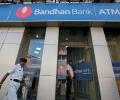
Bandhan Bank said on Monday that it has been empanelled by the Reserve Bank of India (RBI) to act as an agency bank to facilitate transactions related to government businesses. The RBI's decision will help Bandhan Bank in contributing to nation-building, its MD and CEO Chandra Sekhar Ghosh said. The announcement comes months after a RBI guideline that authorised scheduled private sector banks as agency banks of the regulator for the conduct of government business.

"We are exploring if Indian oil firms can open accounts in banks like Dubai-based Noor Islamic Bank so they can undertake a direct transfer of money for oil they buy from Iran," a senior government official said.

Flipkart-backed fintech firm super.money is aiming to be among the top five players on the Unified Payments Interface (UPI) leaderboard by the end of this year, a senior company executive has said. The company, which rolled out its beta version in June this year, has processed about 10 million transactions till date. "We have a target of 100 million transactions for the end of the year.

Rediff.com, one of India's pioneering internet companies, on Tuesday announced the appointment of Mr Vishal Mehta as its new Chairman and Managing Director. This key leadership change follows Infibeam Avenues Ltd's acquisition of a majority stake in Rediff.com.

Payments banks are niche banks which will be allowed to function with several restrictions.

'I wonder if they will keep it up after the elections.' 'I fear they'll start questioning eligibility -- income, age, bank accounts -- and eventually stop the scheme altogether.'

Multiple organisations of different kinds with overlapping goals would be a dream situation for those who believe in competition and innovation.

Soon, one will be able to pay utility bills at the local supermarket, while buying groceries, with the RBI allowing the setting up of payment banks.

'Whether I am optimistic or pessimistic is not the issue; I am just going by the evidence available.' 'The Indian economy and financial sector are now well-placed and very resilient in dealing with any kind of spillover coming from the external world.'

More than five years ago on an April evening, cash-starved Jet Airways announced temporary grounding of operations after flying as a full service airline for 25 years. Since then, more than 20,000 jobs and money worth thousands of crores owed to lenders, vendors and passengers evaporated while awaiting an insolvency resolution. And today, the Supreme Court ordered the airline's liquidation, marking the formal completion of a turbulent journey into the sunset and shattering lean revival hopes.

A key indicator of corporate efficiency may now be better than at any time since the turn of the millennium. The net working capital cycle - a crucial measure that tracks the time a company takes to convert current assets like inventory into sales and then collect the money from customers - has seen remarkable improvement. According to data from the Centre for Monitoring Indian Economy (CMIE), the average company needed nearly 90 days to complete this cycle in 1999-2000.

While festive offers can reduce costs, borrowers should also consider the lender's transparency and service quality. Customers need to be mindful of their repayment capacity.

'It has also outlived its initial purpose of reducing physical gold imports.'

Generally, the central bank grants its approval by mid-March, or latest by March 31, but most banks have not received RBI approval on bonus packages this year.

Moody's Ratings on Tuesday projected general government debt to stabilise above 80 per cent of GDP over the next three years, down from 89.3 per cent in 2020-21. "General government interest payments to fall to around 24 per cent of general government revenue over the next two years from over 28 per cent in fiscal 2020-21, although this remains much higher than the median 8.7 per cent recorded by Baa-rated peers," Moody's Ratings associate managing director Gene Fang said in a post-Budget reaction.

The RBI working group's proposal to allow corporate houses to set up banks is a "bombshell" and at this juncture, it is more important to stick to the tried and tested limits on involvement of business houses in the banking sector, according to an article jointly written by former RBI Governor Raghuram Rajan and ex-Deputy Governor Viral Acharya. They also said that the proposal is "best left on the shelf".
